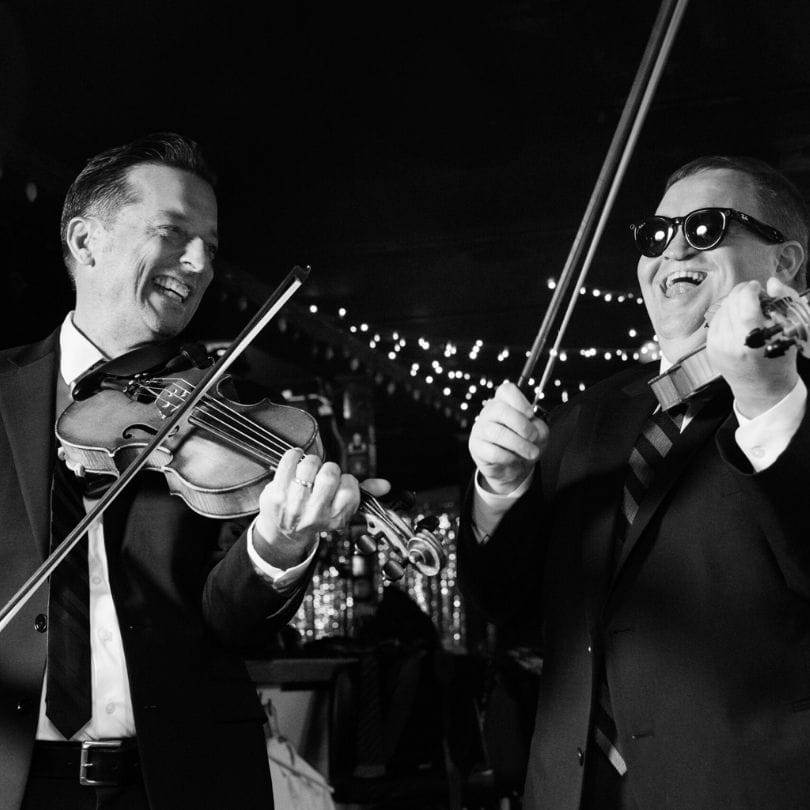
Jason Carter & Michael Cleveland (Fri)
2026 Lineup | 2026 Lineup List | Past Years: 2025 Lineup | 2024 Lineup | 2023 Lineup
Jason Carter Bio
In Lloyd, Kentucky, on U.S. 23, there’s a sign on the Country Music Highway dedicated to renowned fiddler Jason Carter. It was placed there because of his other accomplishments—the Grammy awards, the worldwide tours, and the many other accolades he’s earned through his music. But for Carter, joining the legendary names honored on that stretch of highway just might mean the most. “There’s a certain sound that’s up there that you just don’t hear anywhere else,” he says. “I think that played a big part in how I sound today.”
True to those Kentucky roots, Carter continues to pour all he has back into bluegrass. For thirty years, he has been the fiddle player for the Del McCoury Band—the most awarded group in bluegrass history. He’s won three Grammy awards, including 2018’s “Best Bluegrass Album” with the Travelin’ McCourys, of which he is a founding member. And he’s taken home five IBMAs for “Fiddle Player of the Year,” a staggering number that isn’t quite so crazy once you realize just how many bluegrass greats have turned to Carter for collaboration.
As a fiddler, Carter has been featured on albums by Steve Earle, Ricky Skaggs, Dierks Bentley, Charlie Daniels, Vince Gill, Asleep at the Wheel, and many more, all in addition to his tireless touring and recording with Del as well as the Travelin’ McCourys. On Carter’s forthcoming solo album, Lowdown Hoedown, listeners may recognize instrumental contributions from such legends as Jerry Douglas or Sam Bush alongside vocals from young trailblazers like Sarah Jarosz or Billy Strings. This time, though, Carter is singing lead.
The album’s namesake track, a good-time duet with longtime friend Dierks Bentley, plays on Carter’s dexterity on the fiddle with an flashy solo—while also showcasing his charisma as a frontman and vocalist. “Good Things Happen,” a Jamie Hartford number with vocal harmonies from Aoife O’Donovan, marks the kind of tender moment fit for a first dance or sweet serenade. But Lowdown Hoedown has its somber side, too.
“Dust Bowl Dream,” a wistful narrative about a depression-era farmer, builds on its slow pace and vivid lyrical imagery with powerful harmonies from Sarah Jarosz and twin fiddles from Carter and fellow IBMA-winning fiddle player Bronwyn Keith-Hynes. The John Hartford tune “Six O’Clock Train” marks a slower, more ominous moment, calling in vocal harmonies and guitar from Billy Strings.
Scattered across the album, too, are hints of the influences that have shaped Carter’s sound throughout his life. A guitar player since childhood and a fiddler since 15 (the age when he swore that someday he’d play in the Del McCoury Band), Carter inherited his love for bluegrass from his father, a musician himself, and grew up playing at jams, festivals, and campgrounds across Kentucky. After he graduated high school, he took his talent as a fiddler on the road professionally: first with the Goins Brothers, then at 19 with the Del McCoury Band, and later with the Travelin’ McCourys.
In the decades since, he’s seen the bluegrass community evolve and expand. “The bluegrass fans, they’re pretty loyal,” he says, noting that he’s found a similar kinship sharing stages with jam bands like Phish and Leftover Salmon, too. “They stick behind you, they’re there for you.” Carter mirrors that loyalty with his own—loyalty to his craft, loyalty to the road, and loyalty to the career path he’s dreamt of since childhood. With Lowdown Hoedown, Carter shares the fruits of decades’ worth of on-the-road experience, spectacular musical sensibility, and genuine excitement for what bluegrass can be.
MICHAEL CLEVELAND – LOVIN’ OF THE GAME
With the sweet and good things in life, there always comes darkness. This is a lesson that GRAMMY-winning fiddler, Michael Cleveland, knows all too well. In 2021, two of his dearest and oldest friends passed away. Bill Wolfe and Eddie Wells were two of the best local bluegrass musicians in his hometown in southern Indiana—they were two of the people who had inspired him to pick up the fiddle at just four years old, so their passing hit hard. “More than ever, losing both of them made me realize that life is short and is also what you make it,” says Cleveland. “It made me really stop and think of all the people in my life who have influenced me in life and music, and to not take anything for granted.”
With his sixth solo studio release, LOVIN’ OF THE GAME, veteran fiddle virtuoso Michael Cleveland seizes his opportunity at this one wonderful life and swings for the rafters. The album positively hums with energy. Not beholden to one specific genre or pigeonholed label, it showcases Cleveland’s inclusive musical nature—placing value in the process over the output. It is in this release of control that we find something truly sublime: the sound of artists working together in the act of creation without regard for any preconceived notion of what “should” be. The sound of genuine musicianship.
Built upon a rock-solid foundation of bluegrass prowess, LOVIN’ OF THE GAME showcases the power of fusion, bringing truth to the phrase “greater than the sum of its parts.” On each song, Michael Cleveland partners with the all-star community of musicians he has built, finding the tools to uplift the unique voices of each of his collaborators. In one moment, he takes us on a loopy dialogue between fiddle and guitar with two-time IBMA Guitar Player of the Year Billy Strings, delivering a spacey jamgrass rendition of 80s rock classic “For Your Love.” The next, he breaks our hearts with “I Wish I Knew Now What I Knew Then,” a jukebox-ready country waltz pining over lost love, with Cleveland’s lonesome fiddle accompanying Country Music Hall of Fame member Vince Gill’s crooning vocals.
Collaboration serves as the bedrock of the album, and that outreach towards community extends well beyond the studio. Though it may be the track that sounds the most like dust bowl-era Appalachia, in actuality “Sunny Days Are Comin’ Once Again”—featuring Jeff White and Dan Tyminski in tight vocal harmony—is as new as they come. Written in the heart of the COVID-19 shutdowns of 2020, this song came to Cleveland by way of the songwriter Greg Poulos, who hired Cleveland to produce and perform on his original recording. Cleveland credits sessions like these with keeping him grounded and motivated during the darkest days of the pandemic, and this song in particular stuck in his ear. When it came time for him to make his own album, he couldn’t resist taking the lead to record it himself.
Similarly, the instrumental “Contact” is the result of a connection Cleveland made with Matt Carson, another visually-impaired musician, who taught him how he could use the industry standard recording platform, ProTools. It was this knowledge of recording that allowed Cleveland to make this track with no live session or physical interaction between collaborators Cody Kilby, Barry Bales, and Béla Fleck. Rather, each musician was able to build on the previous artist’s work, with Kilby recording the guitar part first, then Bales bringing in the bass line, followed by Fleck filling in banjo, and finally Cleveland adding the
dazzling top notes of fiddle and mandolin. Despite being recorded across time and space, the tune captures the vigor and ingenuity of each of its contributors.
“People know me as a traditional bluegrass fiddle player, which is what I love to do,” says Cleveland, “but this album is more than just the pure tradition. It’s a little bit of a departure for me.” Nowhere is that more pronounced than in the lonesome and moody “One Horse Town,” a cover of the 2012 release from Southern rock band Blackberry Smoke. Featuring vocals from Blackberry Smoke’s Charlie Starr and Cleveland’s longtime Flamekeeper bandmate, Josh Richards, and buoyed by the steady instrumental backing of Flamekeeper, Cleveland’s rendition coaxes out the tender melancholy of life in a town too small to sustain itself. Leaning into the weight of responsibility and the pain of hoping for more, Cleveland’s fiddle playing anchors the listener into the listlessness of an arrested life—it could almost drown you.
Thankfully, Cleveland releases the spell and grants reprieve with the eponymous final track, “The Lovin’ of the Game.” Inspired by The Johnsons’ up-tempo cover of the Judy Collins classic, Michael Cleveland & Flamekeeper put a joyful, hard-driving spin on the dreamy 70s folk ballad, delivered with the kind of vigor that makes audiences fall in love with bluegrass to begin with. “The song is about prospectors and gamblers,” says Cleveland, “but for me, the ‘loving of the game’ has always been loving being a part of the musical community and all that being a musician has brought to me.”
Michael Cleveland is the most awarded International Bluegrass Music Association Fiddle Player of the Year, with twelve wins to his name. He is a six-time winner of the IBMA Instrumental Performance of the Year and his band, Michael Cleveland & Flamekeeper, has won Instrumental Group of the Year seven times. In 2019, Cleveland was the subject of the documentary, Flamekeeper: The Michael Cleveland Story and his album TALL FIDDLER was awarded the GRAMMY for Best Bluegrass Album. Michael Cleveland was inducted into the National Fiddler Hall of Fame in 2018. He received the National Endowment for the Arts National Heritage Fellowship in 2022. His new album, LOVIN’ OF THE GAME, will be released by Compass Records on March 3, 2023.